Knowing Your Limits

Why limits matter
Five minutes of swimming puts the same physical demand on your dog as a 15 kilometre run. That is because water compresses the rib cage and lungs, making every breath harder work. The muscles are working against water resistance in every direction. It is an extraordinary full-body workout — and that means it is very easy to overdo it without realising.
Signs of fatigue
Watch for these signals during every session. Your dog's head dropping lower in the water — a tired dog cannot keep their head as high. Paddling that becomes frantic or uncoordinated instead of smooth. Slower response to your voice or toys. Trying to climb on you instead of swimming independently. Any of these mean it is time to stop immediately and get your dog out of the water.
Cold swimmer's tail
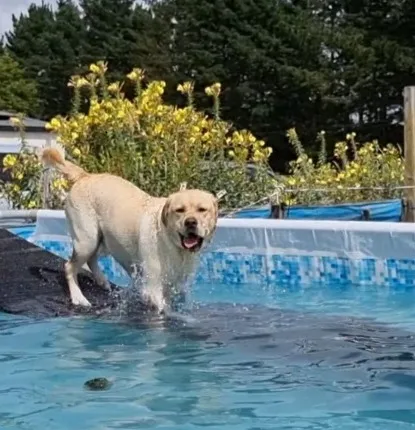
This is a condition where your dog's tail goes limp after swimming — it hangs straight down and they cannot wag or lift it. It is caused by overexertion of the tail muscles, often combined with cold water. It looks alarming but usually resolves in a few days with rest. However, it is painful and completely preventable.
To avoid it: keep sessions short, warm your dog up afterwards with a good towel dry, and do not swim in very cold water for extended periods. If your dog's tail goes limp after a session, rest completely until it recovers before swimming again.
Water temperature
Cold water tires dogs faster and increases the risk of cramping. If the water feels cold to you, it is cold for your dog. Shorten your sessions accordingly. In winter or cool climates, consider a dog wetsuit for breeds with thin coats or low body fat.
Age and health considerations
Puppies and senior dogs tire faster. Puppies should have very short sessions — a few minutes at most — because their joints and muscles are still developing. Senior dogs benefit enormously from swimming because it is low-impact and supports arthritic joints, but they need shorter sessions with longer rest breaks. If your dog has any health conditions, speak to your vet before starting water work.
The golden rule
Always finish while your dog still wants more. If you are wondering whether to do one more retrieve, the answer is no. Get out. A dog who leaves the water wanting more will be excited to come back. A dog who leaves exhausted will dread it.

Fiona's Tip
I have had dogs who would swim all day if I let them. Newfoundlands especially — they are bred for water and they absolutely love it. But even the strongest water dogs need limits. I once had a client whose Labrador swam for 45 minutes straight because he was having such a great time. The next day he could barely walk and his tail was completely limp. It took a week to recover. Now I am strict — ten minutes, out, towel, rest. You can always come back tomorrow.
Duration | Practice

